The Bloem Diaries – Part 2: Kitchen politics

When someone asks you whether you mind sharing a room with someone from “another race” this messes with your brain in unpredictable ways. And you resent the person who implanted that question in your head. Now it sits there, like an intruder among all the other utterances of everyday life that you remember hearing. It hits you there and then that this question will leave an indelible mark on your mind, that your mind has been polluted, Chernobyl style. What is the half life of apartheid? In Bloemfontein at least, most off-campus residences still practice racial segregation. It is often sugar-coated, asking applicants to indicate their “preferred room mate” on a form that can be interpreted as asking for a specific name when it is actually used to indicate race.

Alamnesh cooks Shuro. While cooking, she names all the ingredients for me in Amharic and English. She later shows me the book she uses to learn English. It is written by an Ethiopian author who writes “BA in Journalism 2015” after his name, apparently to establish his expertise in language teaching. Many sample sentences involve conversations one might have in shops. Some sound very British and stiff, while others are translated so directly from Amharic that you have to mentally read them with an Ethiopian accent for them to make sense (“How are you?” “Thanks to God, I am well.”). Alamnesh needs to improve her English if she wants to get work in one of the shops in town.

I think of the Habesha shop keepers, embedded in a complex social network of dependencies and moral obligations. They are under pressure from their community to give work to Ethiopians, yet the South African context makes it crucial for them to provide work to locals. This is their best strategy to escape the wrath of impoverished communities in South Africa – a lesson learned through bloodshed a few years ago. Like pretty much every other group, African migrants too have become a target of violence in South Africa.

To the Habeshas I interact with, the difference between them and black South Africas could not be greater. They are perfectly oblivious to the fact that most white people cannot even make the difference between them and the local black population. “All the black students are thieves, you have to be very careful.” This warning from an Ethiopian PhD Student catches me off guard and I am not able to hide my disapproval of this kind of blanket statement. “Ok, maybe not all of them. But many.” The Ethiopian students here do not go out much. Compared to their rural home town in Ethiopia, Bloemfontein is a dangerous place. I understand the fear, but I at least want it to be evenly distributed and mess with people’s certainties a little bit. “You know, many of the white students are armed. Those are the ones I am most afraid of.” He considers this and agrees.

Food for thought.

“Do you mind sharing the kitchen with another race?” For the first time I feel genuinely angry. Not sad, just boiling with anger. “We have to ask you this question.” In some countries you would go to jail for asking me this question. “I mind sharing the kitchen with someone who answered yes to that question…” Her fake smile disappears but she still needs to sell her product, off-campus overpriced luxury accommodation for rich kids and visiting researchers looking for a simple solution to their Bloemfontein housing problem. Later, the manager is called and I am duly introduced (“This is Carmen, she wants to rent a room, she does not mind sharing with another race.”) Not even “a person of another race”, no just “another race”. Will they all fit in my kitchen? One billion Chinese, all at once?

They tell me that I will be sharing the kitchen with a coloured girl who already shared with a white girl before so she will not mind. I wonder whether the same girl would be as comfortable sharing the kitchen with a black girl. If I move there, I might try to find out. The financial details are explained to me by the financial manager. I have to sit in his office and as soon as the girl leaves he closes the door and apologizes for her lack of professionalism – she indicated a lower price than he will charge me now and he has no hesitation in making it look like it is her fault. As a result, I no longer feel angry at her but am annoyed at the smugness of my new interlocutor.

I cannot resist the temptation to ask him about the compulsory race question I was presented with earlier. I am curious to get his take on this. How would a black South African man explain this issue to a white woman from abroad? I give it a shot. The mental gymnastics he subsequently engages in are impressive. “You see, in South Africa it is like this. And not only white and black, even when I have Zulu and Sotho students, I cannot put them together because they have different cultures. And the Indian students like to live with other Indians because they are all vegetarians and so they do not want to share the kitchen with someone who eats meat.” Hm. “I am a vegetarian.” Also, on what planet is ‘black people also hate each other’ a good excuse for any of this? “Yes, but I am sure you do not mind sharing with someone who eats meat!” He triumphantly uses my lack of racial preference against me: the option ‘Do you mind sharing the kitchen with the same race?’ does not exist. And yet, after my experiences in the past days, that is the question I would have answered with a resounding yes.

I do not like how I feel right now. I feel like I need to justify myself somehow. He continues his explanations, apologizing again. Like the girl, he comes across as fake, just selling a product trying to find the right buttons to press for this particular customer. “I apologize but it is like this. I understand it might seem strange to you, I hope that three weeks from now you will come back and tell me that you have now gotten used to our context.”

“You don’t need to apologize. No, it is not strange, it is actually sad.” He swiftly agrees with me. “Yes, you are right, it is very sad.” I suspect he would have agreed with me regardless of what I said. If segregation is what customers want, then that is what for-profit residences will offer. Most customers seem to want this.
The Bloem Diaries – Part 1: Race and the city

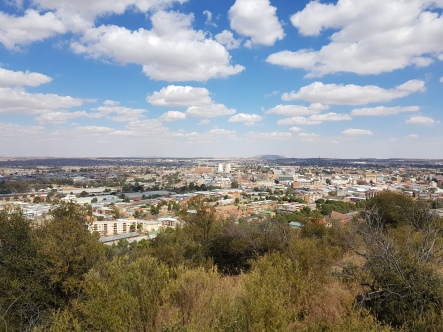
In August 2017, I started my post-doctoral fellowship in the city of Bloemfontein, South Africa. A year prior, I visited the city and the campus because I did not want to go to a place not knowing what to expect. Once I found out what to expect, I decided to go anyway.

20170820_124415

In a place characterized by division, stark racism, violence and conservatism, I found amazing stories of progressive thought, friendship and courage. Stories of ‘locals’, stories of migrants, stories of people crossing boundaries that are much less rigid than one might assume at first sight. I found these stories because, even though I was told not to leave campus, for it would not be safe, I decided to go out every once in a while.

To protect the anonymity of protagonists, many of these stories have a fictional component, but they are rooted in the reality of a city that, as soon as you leave it, seems like a surreal mirage that only exists in your imagination.

Little Ethiopia

The city centre becomes busy on Saturday. All of a sudden, Bloemfontein looks like any other African city, the hustling and bustling of shops, people crossing the street where ever they please, people shopping and chatting on the street. Most shops in town are run by the Ethiopian or “Habesha” community. The language mix in the shops is fascinating. Shop keepers employ a mix of Habeshas and South Africans and mutual learning takes place constantly. The shop keepers speak Amharic, English and have a basic command of Sesotho, while their staff, largely fluent in Sesotho and English, will speak Amharic with the customers they identify as Ethiopian. There is no fear of making mistakes, South African staff will happily throw in the odd Amharic word (qonjo, salamnew, tinish, kamis, chama…).

Most foreigners or even white South Africans (if they ever set foot in these stores, which, based on how staff reacted to my presence, seems improbable) are likely oblivious to this complex mix of languages and cultures, as they will perceive all people in the shop as belonging to the same group: black people. There was no hostility towards me in the city centre. Indeed, my very presence there seemed to indicate that I was somehow weird, not South African, a different kind of “other” than the one people react to negatively in this context.

Alamnesh wants to buy a dress for church. She tries on several, all pink. She does not like anything with too many complications, she prefers simple designs without lace or buttons. The dress has to be long. “I short” she complains every time she tries on a dress that inevitably ends up being way too long for her. She also needs shoes. And eyeliner. And lip balm. But the transparent one, not the one with colour. I suspect that all this is for church. There is considerable excitement about going to church tomorrow. I agreed to drive them to mass, they normally cannot go there as it is out of town and starts at 6am. We leave without buying a dress but she has another one at home. Later on, they will tell me again that I don’t have to take them to church, that it is fine, no big deal, I can just sleep in the morning. But I know that all the preparations being made are based on the assumption that I will be there tomorrow morning.

Yonatan owns the clothes store. He speaks Amharic, English and Sesotho (main use case: yelling at his staff). One of his employees in particular is eager to speak in Amharic, although she knows barely more than a few words. To work at one of the shops in town, Alamnesh needs to learn English. Maybe in a few months she will also know some Sesotho. It is not language mastery in the sense we understand it in interpreting, rather, what is happening is rapport-building through language, similar to what we find in anthropology. The language is mastered enough to make the interlocutor trust you, to show them “I am similar to you, I respect you, I am interested in your way of being, in who you are, you can trust me.”

Learning a language is a way of acknowledging each others’ humanity. Nothing more but nothing less.

The two girls in the shoe shop laugh when they see me. Then exchange a few words in a language I cannot understand before looking at me again. “Whitey” one of them says in my direction, laughing. Whitey. Blunt like that. They do not even try to sugar coat the fact that I am wearing the wrong skin colour for the occasion. But she does not say it in a demeaning way, rather, she says it in an encouraging way, in a ‘we are surprised but happy to see you here’ kind of way. I laugh with them and reply “Yes, apparently. Nothing I can do to change that, can I?” They laugh. “No, true, you can’t. But it is good. Welcome.”

Hair is cut, shaved and braided on the sidewalk, in broad daylight, next to small stalls where women sell goat (or sheep?) heads and feet in transparent plastic bags. I have never seen this kind of open air hair dressing in a large town, it somehow makes the city centre look poorer and more miserable. The strands of hair and extensions on the sidewalk give the street a somewhat sinister look. My brain creates associations with piles of human hair seen on photos taken in a different context decades ago – a context I have spent more time than usual thinking about since I arrived in Bloemfontein.

One of the shops has hired a DJ. He stands at the entrance with his mixing table, over-saturated loudspeakers blasting Hip Hop beats onto the sidewalk. A man who looks both drunk and homeless dances to the music as if his life depended on it. Like the loudspeakers, he is having a blast. Some passers-by laugh and enjoy the spectacle, others ignore the guy as if he was the most normal thing in their world. The DJ looks at me, pleadingly, as if wanting to apologize that I have to witness this. And yet,this is what I came to see. Just life on a Saturday morning.

“Do you like this city?” Alamnesh asks me. I want to say no. I think of the strands of hair on the sidewalk, the goat (sheep?) heads being sold in transparent plastic bags, without skin but with teeth, the three keys, two remote controls and one access card that separates my room from my office, the constant reminders that people are out to rob and rape you, that it is not safe. But I do not want to discourage her, after all, she has to live here and is likely to give birth to a child in this town. “It’s okay, I think I will get used to it.” My reply is half affirmation, half resolution. “Me no like it” she says, looking determined.

Yet, for about two hours this Saturday, Bloemfontein became just a normal African city.

I was able to forget about the guy writing his PhD about the positive aspects of fascism in Europe.

I was able to forget about the girl who explained to me that it is not possible for students of different races to share the same apartment because the black men do not respect “their” women, so they will just walk in and out of a black girl’s room whenever they please and white parents do not want their daughters to be ‘exposed’ to that (i. e. raped).

I was able to forget that a professor had told me that last year during the racial violence at the University of the Free State (#ShimlaPark), white parents came to campus with their pick-up trucks, armed with baseball bats, ready to beat up black students. That residence managers had to hide terrified undergrads in different campus buildings.

I was able to forget about the three white post-graduate students who gave a theatrical presentation on how black students perceived these incidents on campus last year, well-meaning and yet totally oblivious of their own positionality in all of this. Whitesplaining should be a word in this country.

And yet, research on identity among local students also reveals a darker, self-deprecating side. When no one else listens, students will say things like “I am ashamed of my skin colour. I am ashamed of being white.” I wonder how much of the white anger is due to this deep feeling of inadequacy, this not knowing how to “be” in this “New South Africa” and where else to be if not here. If 1970 was a place, I suspect quite a few white South Africans would want to emigrate there.

It all comes back when we reach the mall. All of a sudden 15 muscular young white men in shorts walk into the mall and start singing. I am legitimately scared for a second (anything sung by 15 males in shorts sounds like a war song), before realizing that it is probably just a bachelor party. The tension messes with your brain here. Everything looks threatening when you are constantly told to be scared.

As we walk down the aisles and look at shop windows, I decide to follow up on our earlier conversation. “So, Alamnesh, you do not like this city?” She smiles “I do like it.”

The mall is a safe place.

The tale of the good migrant

Habib is a hard-working father of three who left Syria with his family in 2013 in order to apply for asylum in Germany, where some of his family members have lived for decades. Habib speaks English and immediately signed up for German courses at the local community centre in Karlsruhe. He is a trained electrician, which happens to be a highly in-demand skill in Germany, so it was not difficult for him to find work. Habib is Muslim, but not overly religious. He does not think that Sharia law should apply in Europe, nor does he expect his wife or his daughter to cover their hair when leaving the house. He fasts during Ramadan, but that’s about it. Habib’s children are going to primary school. One of their older cousin’s who was born in Germany helps them with language and homework. Their mother, Fatma hopes to learn German quickly, so that she can start working as a nurse again, which was her profession in Syria.

Habib is a good refugee. He should be given asylum. Right?

The narrative of the good migrant or good refugee has emerged as a genre in its own right – NGOs working with refugees and migrants have “success stories” plastered all over their websites, while the UNHCR tells us “refugee stories” combining text, photos and videos into accounts of suffering, resilience, survival and, quite simply, a deeply shared sense of our common humanity. These stories fulfill an important purpose: they aim to make readers feel empathy. In an age of growing desensitization to human suffering, where we increasingly think of refugees and migrants “in bulk” rather than as individuals, these stories are important and necessary.

However, they also have potentially nefarious consequences.

A rather disturbing example of the “good migrant” genre is Deutsche Welle’s Documentary “Black Skin, German Passport”.

It goes to painstaking lengths to portray the life stories of German nationals who at some point in their lives immigrated to Germany from different African countries. The protagonists seem to have been selected exclusively based on their “black” skin colour, since they do not have anything in common beyond that. The underlying message being conveyed is that these “black Germans” are exceedingly good at being German, to the point where their stories sometimes seem like satire: a young man who came to Germany from Cameroon when he was a baby is training to become a police man, a woman who migrated to Germany from Ghana after she married a German has specialized in the art of cake baking, while a man in his 50s who left Angola in his early 20s to go to university in the GDR and was unable to return after war broke out in his country of origin is now the proud new owner of a “Schrebergarten” somewhere around Dresden. The documentary depicts him listening patiently as representatives of the owners’ association recite dozens of rules about what he is allowed to plant exactly where on his tiny plot of land. I personally would have struggled not to hit those small-scale bureaucrats on the heads with their folders, but then again, I do not have to prove that I am a good German because I am already white…

This precisely is the problem. While different in tone and quality, all these narratives have one thing in common. They produce a one-dimensional representation of migrants or refugees as inherently good or flawless individuals, who are willing and able to seamlessly integrate into Western society by adopting European values. This, precisely, is where these stories can be detrimental. Although they aim to produce positive stereotypes, they are still producing stereotypes. These stereotypical representations are inherently simpler and less nuanced than the underlying reality. They pander to those on the European right who think of “integration” as a process of completely abandoning one’s original culture in order to fit in with a new one. They are based on an understanding of culture as static, set in stone. They aim to reassure those who believe that the arrival of large numbers of individuals from outside Europe will change European culture by implying that this is not the case. That is a wrong and dangerous idea that, in the long run, will create more problems that it solves.

These stories anchor a false narrative in people’s minds, namely that migrants or refugees should be welcomed because they are good, and that what counts as good is defined according to European values.

People leave their countries for different reasons. War, natural disaster or famine are extreme situations pushing millions to leave everything behind. They are deeply traumatic experiences for any human being, that might leave a lasting impact on their psyche and affect their personal relationships for years to come. However, these experiences do not in and of themselves drastically reduce the complexity of human interactions or societies. Before the war, Syria had doctors, nurses, laborers, unemployed youth, secular individuals, religious fanatics, Christians, criminals, old people, children, mentally ill people, rapists, gays, lesbians, progressives, conservatives… whatever groups you like to think of as making up a complex society, Syria had them. Syrian refugees are representative of Syrian society in all its complexity. They differ from anyone else only in that they are victims of a conflict that has killed thousands and left formerly beautiful cities in rubble. They qualify for asylum in third countries, including European countries, because they have been displaced by armed conflict.

Being a good person is not a requirement for asylum, nor is adherence to certain values that we think of as appropriate.

The situation is of course different for migrants. Indeed, some argue that migrants have no inherent or inalienable right to remain in their host country and that their permission to stay could be withdrawn at any point, namely because they are seen as “not integrated enough”. I do not agree with this idea to start with, however, it becomes truly insidious when one considers that second generation immigrants who are born in the host country, as well as naturalized citizens (see Deutsche Welle) are still seen as having to constantly prove their level of integration. The title of Deutsche Welle provides a strong clue in this regard: “Black skin” is seen as the defining feature of these individuals, a feature that no amount of social integration will ever erase, a feature that makes them have to prove their German-ness over and over again.

Migrants and refugees are not all good or all bad. They are full-fledged human beings, who have exactly the same level of complexity as everyone else. Everywhere in the world, some people are great, some people are assholes. But all of them are people and they have rights just by virtue of being people.

Time has always changed societies and cultures. My worldview has been shaped by that of my parents but it is not identical to it. Every new generation radically changes a country. It is therefore only logical to expect that individuals who arrive in a country not through birth but through migration have exactly the same effect. The sooner we accept this reality, the better.

Both asylum and a life in dignity are rights. They are not privileges one earns for good behaviour.


Men on a Plane – Development Sector Edition

I recently watched Paula Stone William’s Ted talk, which I can warmly recommend:

In it, Paula describes how her life has changed since she transitioned from male to female. She starts with an anecdote about a man refusing to let her sit in her assigned seat on a plane.

This anecdote struck a nerve with me, and probably with any other woman who frequently travels for work. Day after day we experience countless small humiliations. We intuitively know that a man would not have these experiences, but we don’t fully understand why.

I recently returned from a short work trip to a country where frankly not many people would go for tourism. Most international travelers go there on mission for their national government, a UN agency, development NGOs or humanitarian organizations. I was travelling as a consultant for one of these organizations.

The flight back, one of the rare connections with the possibility of an onwards flight to Geneva, turned out to be a genuine ‘Who is Who’ of the Swiss development sector: SECO, the SDC, and many major Swiss development NGOs were represented on the medium sized plane. You might wonder how I know this…

There is a reason I choose the aisle seat when I travel for work. I like to get up regularly without bothering anyone. This was a very early morning flight so my hope was that I would spend most of it asleep. Apparently my fellow travellers had other plans. The gentleman sitting next to me, a Swiss national in his 40s (let’s call him ‘Jacques’), had a friend or colleague on the same flight, whose seat was a few rows behind. Given that he was “stuck” in the middle seat, his friend, also a Swiss national but probably in his late 30s (let’s call him ‘Bernard’), eventually decided to stand in the aisle, just next to my seat, for a lengthy chat.

Bernard also seized this opportunity to introduce Jacques to another guy (let’s call him ‘Thomas’), who was sitting directly in front of me and promptly stood up as well, turning around. Thomas was German, in his late 40s. The three men formed a rather close triangle around me and started talking about work. It turns out Jacques was from SECO, Bernard from the SDC and Thomas was country director for a major Swiss NGO.

Bernard, Jacques and Thomas had me surrounded. They talked loudly, directly over my head. It was blatantly obvious that I was trying to sleep – while I was initially listening to their conversation with my eyes closed, I eventually opened my eyes, making it o-b-v-i-o-u-s that they had just woken me up. They never even flinched. They exchanged contacts, tips about where best to go hiking in some of the countries they had been, discussed people they might know in common. They even tried to draw another guy into the conversation “So, do you also work in the development sector?”

As Bernard was travelling back home with his family, his kid eventually joined the conversation, contributing to it mainly by repeatedly pushing my chair and bumping into my leg.

At no point in their conversation did it occur to these gentlemen that I was trying to sleep, that they were invading my space and being extremely inconsiderate to another human being. What was even more obvious: at no point did it occur to them that they could have tried their networking catchphrase (“So, do you also work in the development sector?”) on me and that, unlike the guy sitting next to them, I would actually have been able to answer it.

For twenty minutes, these three men were talking over my head, completely oblivious to my existence. They had created a circle of equals that was literally and figuratively placed above the head of a young woman. Men networking with men. Guys exchanging notes on guy stuff to do in remote regions of the planet (outdoors activities and extreme sports, obviously, it is always about sports). Since they never bothered to question their assumption that I was probably just a student or some kind of volunteer travelling back home, they remained unaware of the fact that I am currently studying the communication practices of the Swiss development sector and that I was furiously taking mental notes. Anthropologists call it direct observation – it is what you do when you are not a participant-observer. That is usually difficult because most human beings acknowledge the existence of another person that is situated in their immediate physical environment… I realized I had inadvertently made a methodological breakthrough: Being a young woman  provides you with an invisibility cloak – who would have known?

Initially, I was angry at myself for remaining silent. Yet, in the face of such an obvious lack of consideration from people whose path I might cross in a professional context one day, I simply did not know what to say. “I am trying to sleep” seemed such a stupidly obvious thing to say to people who supposedly earn their income by being attentive to the needs of others.

After having to ask for permission to cross the aisle four or five times, the flight attendant finally lost it and asked the two gentlemen blocking her path to kindly sit down. They were visibly unhappy, promptly made faces at each other and joked about her being bossy. This was a young woman whose job actually involves telling passengers what to do on a plane.

Had she been a male flight attendant, these men would have complied without so much as a frown. Had I been a male passenger, they would have never dared talk directly over my head and invade my personal space as much as they did.

How do I know this? It is one of the things you learn when you grow up as a woman. By the time you are an adult you have internalized it, by the time you are a few years into your professional life, you have normalized it.

On ne naît pas femme, on le devient.